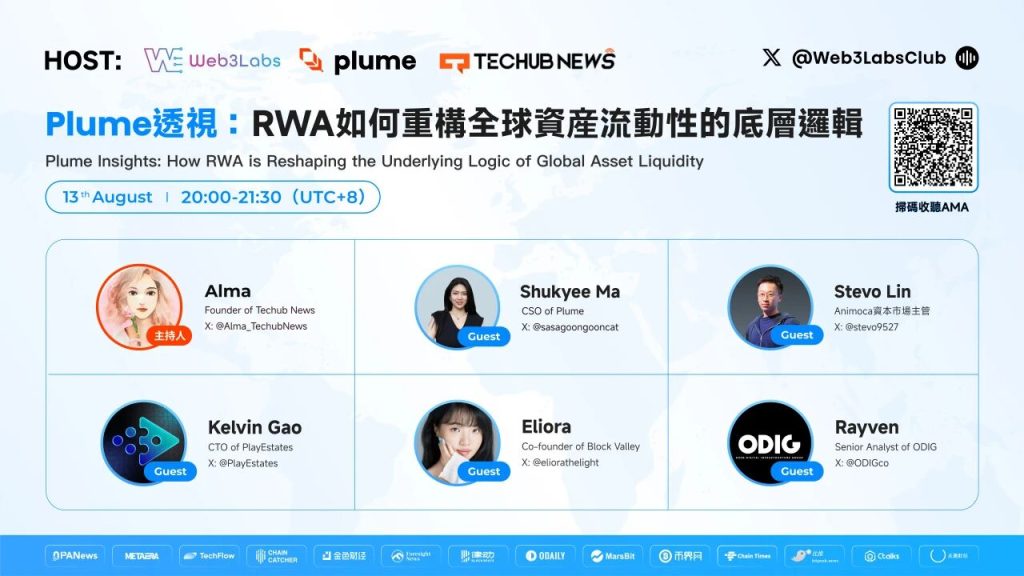
When real-world assets converge with blockchain technology, RWA (Real-World Assets) is rapidly moving from concept to implementation, emerging as a core bridge between traditional finance and the Web3 world. According to industry data, the current global on-chain RWA market accounts for only 0.2% of offline assets. However, with the implementation of Hong Kong’s Stablecoins Ordinance, rising expectations of SEC exemptions for DeFi regulation in the United States, and continued policy openness in jurisdictions such as Dubai, the RWA sector is entering a critical breakout phase driven by both compliance and innovation.
Q1: How Can Traditional Finance Participate? Infrastructure, Solutions, and Opportunities
Shukyee Ma (CSO of Plume)
At present, the core bottleneck for RWA is not the technical issue of tokenization itself, but rather the challenges of distribution, liquidity acquisition, and high compliance costs after assets go on-chain. Many asset issuers still do not know how to reach global users and capital once their assets are tokenized. As an L2 purpose-built for RWA, Plume aims to provide a one-stop solution spanning tokenization to compliant distribution, while encouraging developers to innovate flexibly within an existing framework instead of each bearing the heavy burden of licensing costs independently.
Stevo Lin (Head of Capital Markets, Animoca)
The completion of infrastructure requires solving two major challenges:
Balancing compliance and privacy: How can technologies such as zero-knowledge proofs (ZK) be used to satisfy regulatory requirements including KYC/AML, while still protecting on-chain user privacy?
Establishing rules for secondary markets: A mature RWA ecosystem requires clear frameworks for secondary trading, market making, and liquidity provision, all of which are essential to the circulation of asset value.
Kelvin Gao (PlayEstates)
From a practical technical perspective, in addition to compliance and privacy, ensuring the credibility of project issuers is equally critical. In collaboration with law firms, PlayEstates has designed an off-chain legal process under which users sign subscription agreements, thereby giving investors legal recourse. At the same time, in response to the 90-day lock-up period commonly applied to U.S. real estate RWA products, the team has developed an innovative dual-attribute token protocol to balance compliance requirements with liquidity needs.
Eliora (Block Valley)
RWA assets are highly diverse, and different asset classes face different issues. In her view, future opportunities lie in the development of key infrastructure, including:
- A cross-chain liquidity settlement layer to unify settlement for RWA assets and stablecoins across multiple blockchains.
- A new generation of launchpads with built-in investor protection mechanisms to reduce malicious behavior by issuers.
- A dedicated RWA DEX designed for assets whose value characteristics differ from traditional crypto assets and are less likely to go to zero.
- AI-driven asset management tools to serve the large wave of Web2 users expected to enter the market.
Q2: The Reality and Imagination of RWA — How Can Ordinary Users Participate?
Eliora (Co-founder of Block Valley)
Current market access thresholds are highly tiered, ranging from top-tier financial products such as BlackRock offerings with minimum subscriptions of US$5 million, to Centrifuge SME loan pools with minimums starting at US$500,000, to Ondo U.S. Treasury products at US$100,000, and further down to products such as Pikwe corporate bonds with entry points as low as US$10. At present, the mainstream market remains focused on relatively low-risk, fixed-income-type products, while the more speculative segment of the RWA market remains comparatively fragmented and disorderly.
Shukyee Ma (CSO of Plume)
In the public imagination, RWA often means that “everything can go on-chain,” from concert tickets to movie IP. In reality, however, in order to build credibility for the sector as a whole, platforms such as Plume prioritize assets with strong financial characteristics and controllable risk profiles. At the same time, Plume is committed to lowering the barrier to participation for ordinary users. Through DeFi protocols within its ecosystem, such as Nest, it aims to make investing in RWA as simple as participating in crypto, thereby attracting and serving a broad base of Web2.5 users.
Q3: Hong Kong vs. U.S. Regulation, and the Impact of the Stablecoins Ordinance
Stevo Lin (Head of Capital Markets, Animoca)
Hong Kong’s regulatory approach is akin to an elite education model: the path is clear and the standards are high, ensuring that only “top students” — in other words, assets that are stable and have clear cash flows — are brought to market. This naturally affects the types of projects that choose Hong Kong. By contrast, regulation in the United States is more like a hands-off model: as long as projects do not cross regulatory red lines, they are given greater freedom to explore and innovate.
Shukyee Ma (CSO of Plume)
Project teams should choose their jurisdiction of issuance according to the underlying logic of their assets and their target markets. For products aimed at institutional investors and seeking to reach the Asian market, Hong Kong is an ideal choice. For assets with greater structural flexibility and a desire for more on-chain experimentation, the United States may offer stronger advantages.
Eliora (Co-founder of Block Valley)
Dubai (UAE) provides a third perspective. With its open policy environment, convenient registration processes, and relatively flexible capital flows, it has become a pragmatic option for many RWA projects, especially for companies transitioning from Web2 to Web3.
About Web3Labs
Web3Labs serves as a one-stop gateway for Web3.0 entrepreneurship, with a mission aligned with the policy vision of the Hong Kong Special Administrative Region Government. Through support spanning market-entry services, investment acceleration, technical collaboration, PR services, and compliance assistance, Web3Labs helps global Web3 enterprises establish a presence in Hong Kong and connect with international opportunities. It currently operates offline incubators in Hong Kong, Singapore, Malaysia, South Korea, Hangzhou, and Beijing.
At the same time, Web3Labs has launched a US$10 million Web3.0 Global Acceleration Program and has already formed strategic partnerships with leading international institutions including Neo, Zetrix, ICP, KuCoin Labs, and TON, providing high-quality projects worldwide with comprehensive enablement and acceleration support.